
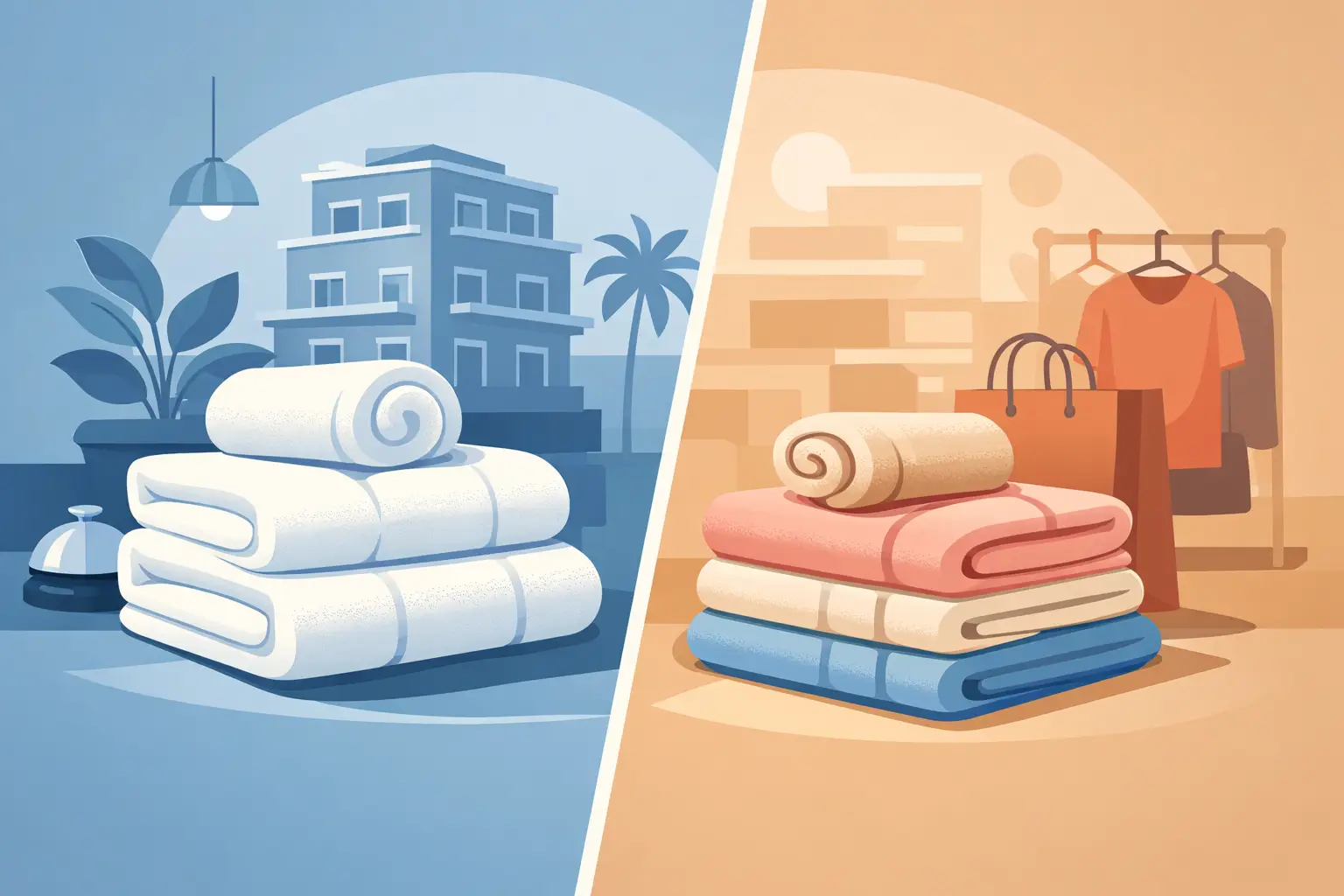
A towel that feels impressive on a store shelf can fail quickly in a hotel laundry cycle. That is the real starting point for understanding hotel towels vs retail towels. They may look similar at first glance, but they are built for different environments, different cost structures, and very different expectations around performance.
For procurement teams, importers, and private-label brands, this distinction matters because the wrong specification creates avoidable cost. A retail towel chosen for softness alone may lose shape, weaken at the hems, or underperform after repeated industrial washing. A hotel towel, on the other hand, is engineered to balance hand feel with durability, absorbency, and repeat-use consistency.
What hotel towels vs retail towels really means
The simplest difference is purpose. Hotel towels are developed for operational use. Retail towels are developed for consumer purchase. That sounds obvious, but it influences every decision in the product itself, from yarn selection to edge construction to how the towel is expected to age.
A hotel towel must perform through frequent washing, fast turnover, and high guest expectations. It needs to absorb well, feel clean and dependable, and maintain its structure after many cycles. A retail towel often has a different job. It needs to appeal quickly at the point of sale, communicate value through packaging or softness, and satisfy home-use patterns that are usually less demanding than hospitality use.
Neither category is automatically better. The better choice depends on where the towel will be used, how often it will be washed, and what the buyer wants the end user to notice first.
Construction standards drive the difference
When buyers compare hotel towels vs retail towels, construction is where the gap becomes clear.
Yarn and fiber selection
Hotel towels are commonly produced with durability in mind. That usually means cotton yarns chosen not only for softness, but also for strength and wash stability. Ring-spun cotton can improve softness and overall feel, while the exact yarn count and twist will affect both absorbency and lifespan.
Retail towels may also use quality cotton, but in many cases they are designed to create immediate showroom appeal. Some feel plush in the first touch because of finishing techniques or pile presentation, yet they may not be optimized for heavy laundering. For home use, that may be perfectly acceptable. For hospitality, it can become expensive.
GSM is important, but not enough
Buyers often focus first on GSM, or grams per square meter. Higher GSM usually suggests a thicker, heavier towel, but GSM alone does not determine quality. A hotel towel with balanced construction can outperform a heavier retail towel if the yarn quality, loop density, and finishing are better suited to repeated washing.
In hospitality, a towel that is too heavy can also slow drying time and increase laundry costs. In retail, a heavier towel may help communicate luxury to the consumer. This is one of the clearest examples of how product success depends on use case, not just headline specifications.
Borders, hems, and stitching
Edge durability matters more than many buyers expect. Hotel towels are typically produced with reinforced hems and construction details intended to withstand commercial laundering. Weak stitching may not show a problem in the first month, but after repeated industrial cycles, it becomes visible quickly.
Retail towels may use decorative borders, textures, or styling details that look attractive in consumer settings. Those features are not inherently a problem, but they are not always ideal for institutional use where simplicity, consistency, and durability tend to matter more.
Performance in use is where hotel towels win
A hotel towel is usually expected to survive far more stress than a towel sold through retail channels. It is washed more frequently, handled by multiple users, and judged by guests who compare the experience to a premium standard.
Absorbency after repeated laundering
Good hospitality towels are designed to remain absorbent after many washes. This is essential because guest satisfaction depends on real use, not first-touch softness. Some retail towels feel excellent when new but change noticeably after repeated laundering. They can become flatter, less absorbent, or rougher than expected.
For hotels, spas, resorts, and serviced accommodations, consistency matters as much as comfort. A towel should perform similarly from one room to the next and from one month to the next.
Dimensional stability and appearance retention
Shrinkage, twisting, and loss of shape create practical issues. A towel that no longer folds neatly, fits the shelf standard, or presents a clean visual line can affect operations and brand image. Hotel-grade production typically gives more attention to wash behavior because appearance after repeated use is part of the product value.
Retail buyers may tolerate more variation depending on the price point and market segment. Hospitality buyers usually cannot.
Whiteness and color fastness
Many hotel programs rely on white towels because they communicate cleanliness and simplify sorting. In that setting, whiteness retention is a functional requirement, not just an aesthetic one. Retail towels often come in broader color ranges and trend-led palettes, which can be a strong sales advantage in consumer markets.
Again, the trade-off depends on the sales channel. Hotels tend to prioritize consistency and laundering practicality. Retail brands may prioritize style variety and shelf appeal.
Cost should be measured over time, not per piece
A lower unit price can be misleading if the towel needs replacement too soon. This is one of the most common mistakes in hospitality sourcing. A retail-grade towel may appear cost-effective at the time of purchase, but if it loses performance quickly, the total operating cost rises.
Hotel towels are often a better value over the full lifecycle because they are built for repeat use. That does not mean every property needs the heaviest or most premium specification. Budget hotels, luxury resorts, boutique properties, and apartment operators each have different requirements. The right sourcing decision comes from balancing guest experience, laundry conditions, and replacement frequency.
For retail and private-label businesses, the equation shifts. The towel must meet consumer expectations at the target price point, support the brand position, and generate repeat purchase or positive reviews. In that context, a retail-oriented construction may be exactly right.
Hotel towels vs retail towels for private-label brands
Private-label buyers sit in an interesting position because they may be developing products for either hospitality customers, retail consumers, or both. Using one towel specification across all channels is rarely the best move.
A hotel collection usually benefits from tighter control over durability, absorbency, and wash performance. A retail collection may need more emphasis on packaging, trend colors, hand feel, and margin structure. Even when both are made from cotton terry, they should not be treated as interchangeable programs.
This is where working with an experienced manufacturer becomes valuable. Custom production allows brands to define the right pile weight, dimensions, yarn composition, border style, and finishing based on the sales channel. Oya Textile supports this kind of tailored development because commercial buyers need more than a generic towel. They need a product that fits the realities of their business.
How buyers should evaluate the right towel
The best buying decision usually starts with questions, not samples. Where will the towel be used? How often will it be washed? Is the goal guest satisfaction, shelf appeal, or both? Will the program prioritize white institutional styles or branded retail presentation?
For hotels and accommodation providers, request specifications that address wash durability, absorbency retention, and construction quality. For retailers and ecommerce brands, look closely at touch, visual presentation, sizing, and how the product supports the target price architecture. For wholesalers and importers, consistency across repeat orders may matter just as much as the initial sample approval.
It is also worth testing towels in real conditions. A sample can feel excellent in hand and still fail under actual laundering or daily turnover. The more demanding the use case, the more valuable that testing becomes.
When retail towels make sense, and when they do not
Retail towels are not the wrong choice by default. They make sense for home collections, promotional programs, seasonal assortments, and consumer brands focused on trend, gifting, or price accessibility. They can also work well when the end user washes less frequently and expects a residential rather than institutional performance profile.
But retail towels are usually the wrong answer for properties that need long service life, consistent presentation, and dependable absorbency after frequent commercial washing. In those cases, choosing hospitality-grade construction is less about luxury and more about operational discipline.
That is why the strongest sourcing strategies do not ask which towel is better in general. They ask which towel is better for the business model, the end user, and the long-term cost of ownership.
The right towel should support your brand after the first wash, not just before the first sale.
